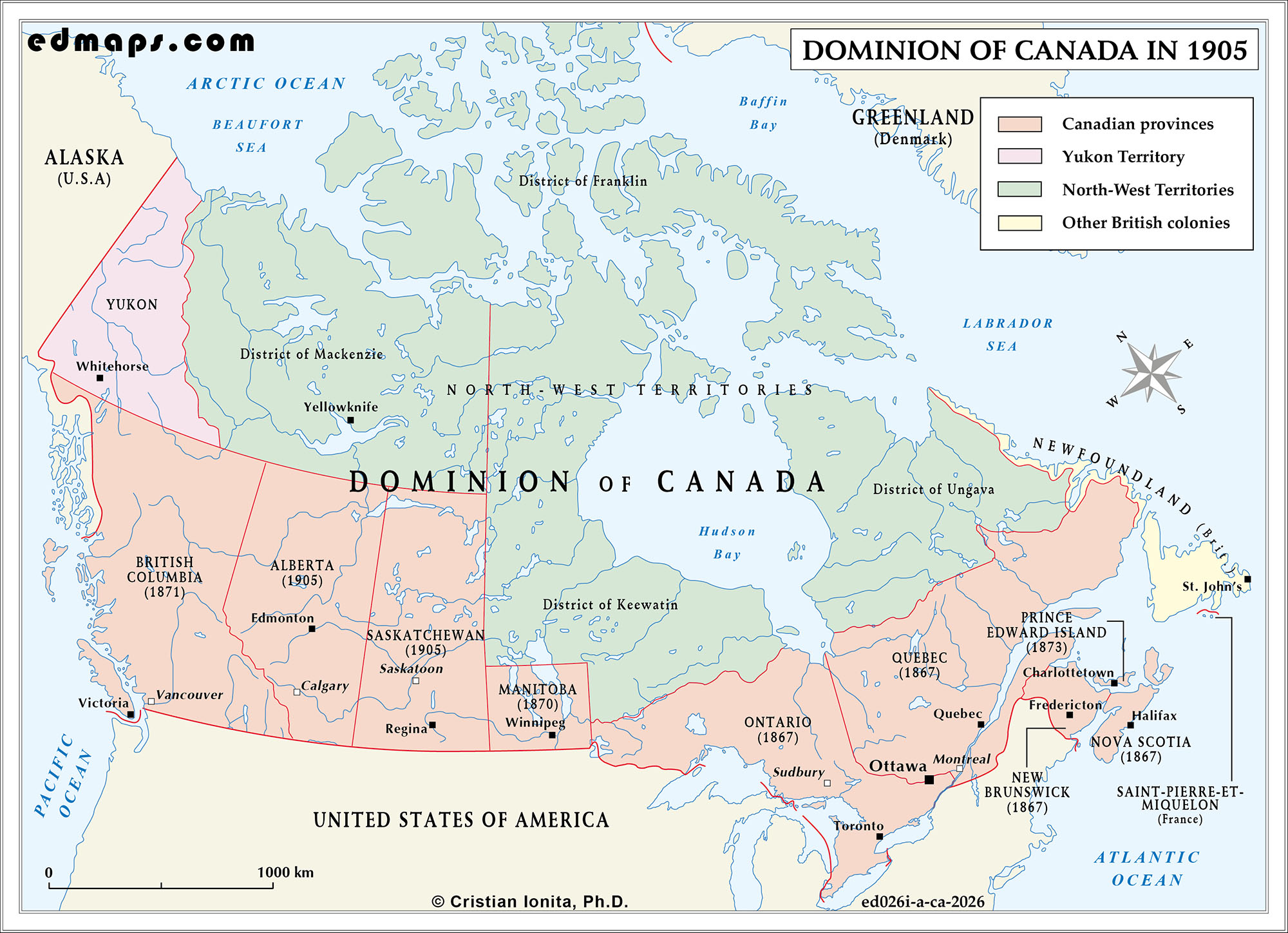
By 1905, the Dominion of Canada had undergone another major phase of territorial reorganization, completing a key step in its westward nation‑building project with the creation of the provinces of Alberta and Saskatchewan. This transformation marked the most significant internal restructuring of the federation since Manitoba’s establishment in 1870 and British Columbia’s entry in 1871.
The Dominion now comprised nine provinces. The original four (Ontario, Quebec, Nova Scotia, and New Brunswick) had been joined over the decades by Manitoba (1870), British Columbia (1871), Prince Edward Island (1873), and, most recently, the twin prairie provinces of Alberta and Saskatchewan (both created on September 1, 1905). Their creation followed years of rapid settlement, railway expansion, and federal efforts to impose stable administrative structures across the western interior.
The remaining federal territories continued to cover an immense northern and western expanse. The North-West Territories, once stretching from Ontario to the Rockies and from the U.S. border to the Arctic, had been progressively reduced as new provinces were carved out. Yukon, separated in 1898 during the Klondike Gold Rush, remained a distinct territory under federal administration. The residual North-West Territories still encompassed the vast Arctic archipelago and northern mainland regions that would later form Nunavut and the modern NWT.
Ontario, with more than 2 million inhabitants, remained the industrial and demographic core of the Dominion, anchored by the Great Lakes manufacturing corridor. Quebec, home to nearly 1.7 million residents, preserved its French‑speaking majority, civil law tradition, and Catholic institutions. The Maritime provinces (Nova Scotia, New Brunswick, and Prince Edward Island) maintained established political structures, though their economic influence had diminished relative to the rapidly growing West. Manitoba, now approaching 400,000 inhabitants, had become a key agricultural and railway hub. British Columbia, with its Pacific coastline and diverse population, continued to expand through resource extraction and transcontinental links.
Alberta and Saskatchewan, each with populations exceeding 250,000, were granted full provincial status with their own lieutenant governors, premiers, and legislatures. Their creation reflected Ottawa’s desire to stabilize governance across the Prairies, regulate land settlement, and integrate the region more fully into the national economy. The federal government retained control over natural resources in the new provinces, a point of contention that would shape western politics for decades.
The federal Parliament in Ottawa continued to oversee national defense, trade, criminal law, and territorial administration, while provincial governments exercised authority over education, property, and civil rights. Representation in the House of Commons and Senate was adjusted to include Alberta and Saskatchewan, further integrating the West into the federal system.
By 1905, Canada had thus taken a decisive step toward completing its continental framework. The creation of Alberta and Saskatchewan signaled the maturation of the Prairie West and the continued evolution of a federation stretching from the Atlantic to the Pacific and deep into the Arctic.