
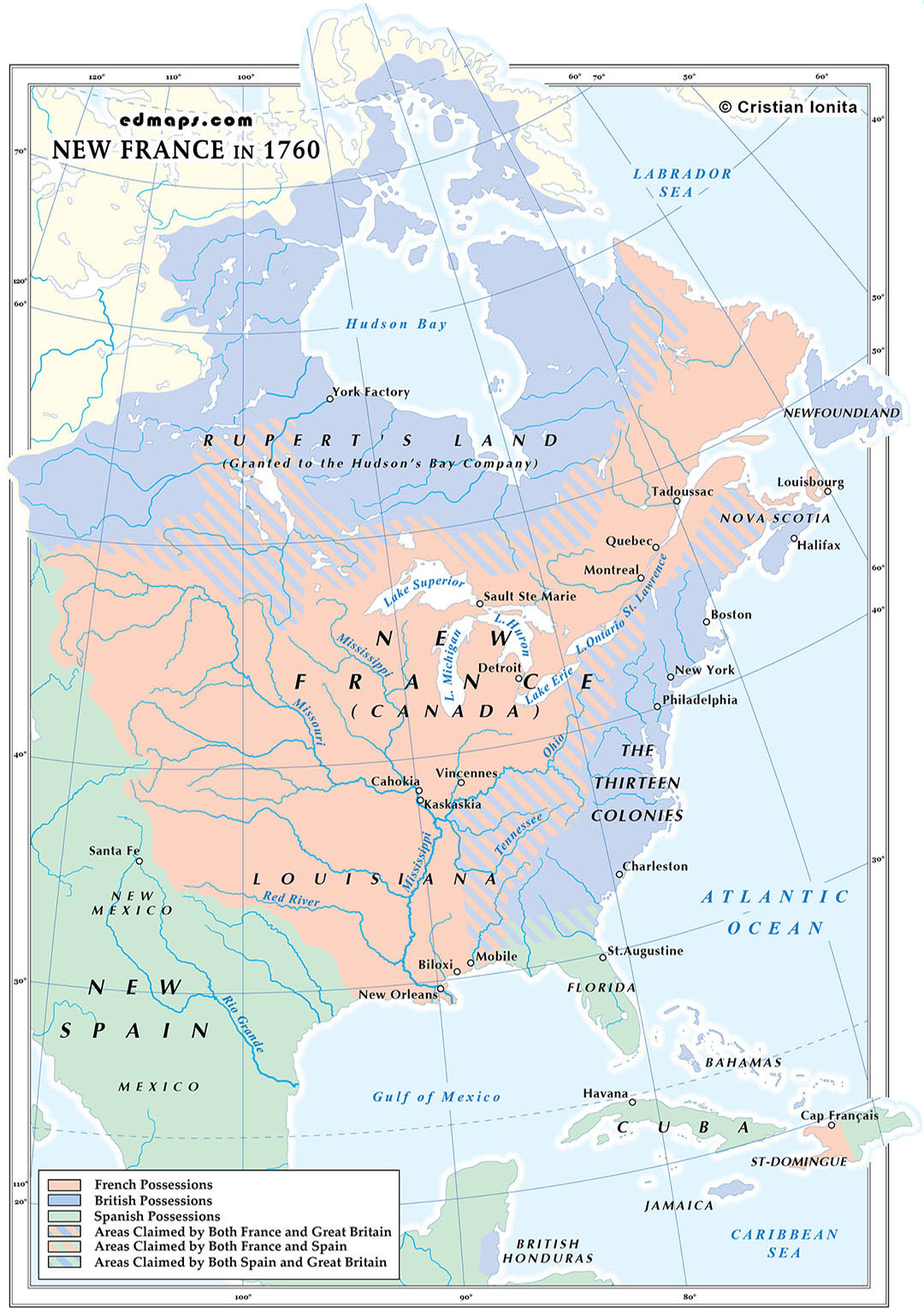
By 1760, the question was no longer whether New France would survive, but how its ending would be written. The colony that had once claimed half a continent was contracting toward its final redoubts along the St. Lawrence, encircled by a British military effort of unprecedented coordination and scale.
The decisive blow had fallen the previous September on the Plains of Abraham, where Montcalm and Wolfe both perished in a battle that lasted barely fifteen minutes yet determined the fate of a continent. Quebec, the colony's administrative heart and the key to the St. Lawrence, had passed into British hands. Montreal, the last significant French-held city, was now surrounded on three sides by converging British columns advancing from Quebec, Lake Champlain, and Lake Ontario simultaneously.
Governor Vaudreuil faced an impossible arithmetic. His remaining forces, ravaged by years of campaign, disease, and Bigot's corrupt provisioning, could neither relieve the pressure nor await rescue from a France increasingly consumed by the European theater of the war. The Atlantic, once New France's umbilical cord, had become a British lake following the naval victories of 1759.
The Indigenous alliance network that had sustained French territorial presence for generations was fracturing irreversibly. Nations that had fought alongside French officers now negotiated their own accommodations with an ascendant British power, recognizing that the conflict's outcome had been settled regardless of their own resistance.
On September 8, 1760, Vaudreuil signed the capitulation of Montreal. The forts, the fur trade routes, the missionary networks, the carefully maintained chain from the Great Lakes to the Gulf, all passed formally from French sovereignty, not through slow erosion, but through a single signature.
New France did not fade. It was concluded.


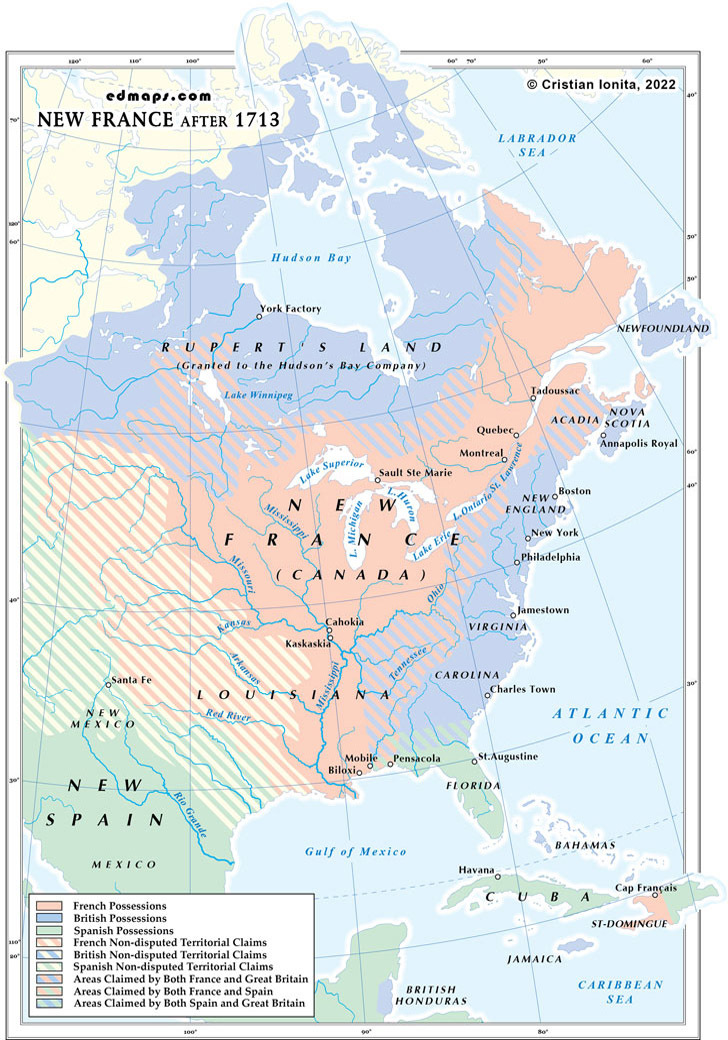
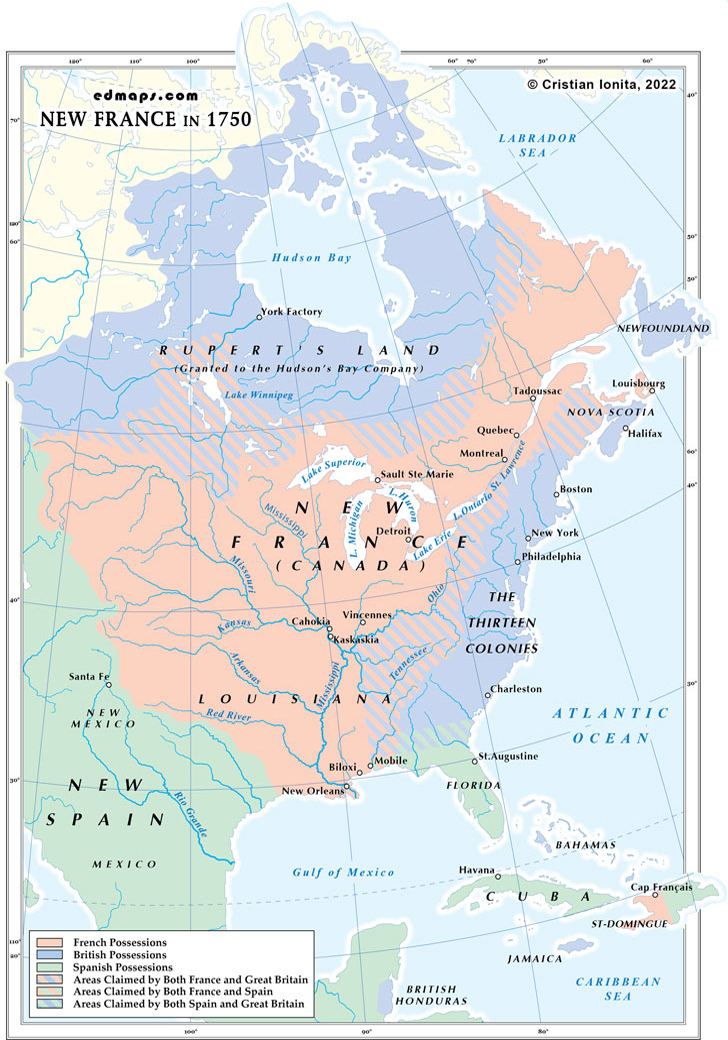
Sources, Methodology & Educational Use: The maps presented on this page are original creations produced for edmaps.com by Dr. Cristian Ionita. Each map is based on verified historical data relating to the territorial evolution, administrative structures, and political history of Canada. The maps are designed according to established practices in historical cartography, including source analysis, period contextualization, and visual clarity. The collection is curated to support teaching, learning, and public understanding of Canadian history, and is intended for educational and non‑commercial use.
edmaps.com — Historical Cartography for Education
edmaps.com provides original maps and curated historical maps designed to support teaching, learning, and public understanding of territorial evolution and administrative history. The original maps are created by Cristian Ionita, and all curated maps are selected from public archives, historical collections, and private holdings, and are presented for educational and non‑commercial use.
© Cristian Ionita. All rights reserved.
Website: https://edmaps.com — Contact: info@edmaps.com
