Sanctioned by the British Parliament on June 22, 1774, the Quebec Act radically redefined the geopolitical landscape of northeastern North America. Driven by the pragmatic governance of Governor Guy Carleton and the looming threat of rebellion in the south, this legislation replaced the rigid frameworks of the Royal Proclamation. It represented a monumental shift from a policy of forced assimilation to one of calculated conciliation toward the French-Canadian majority.
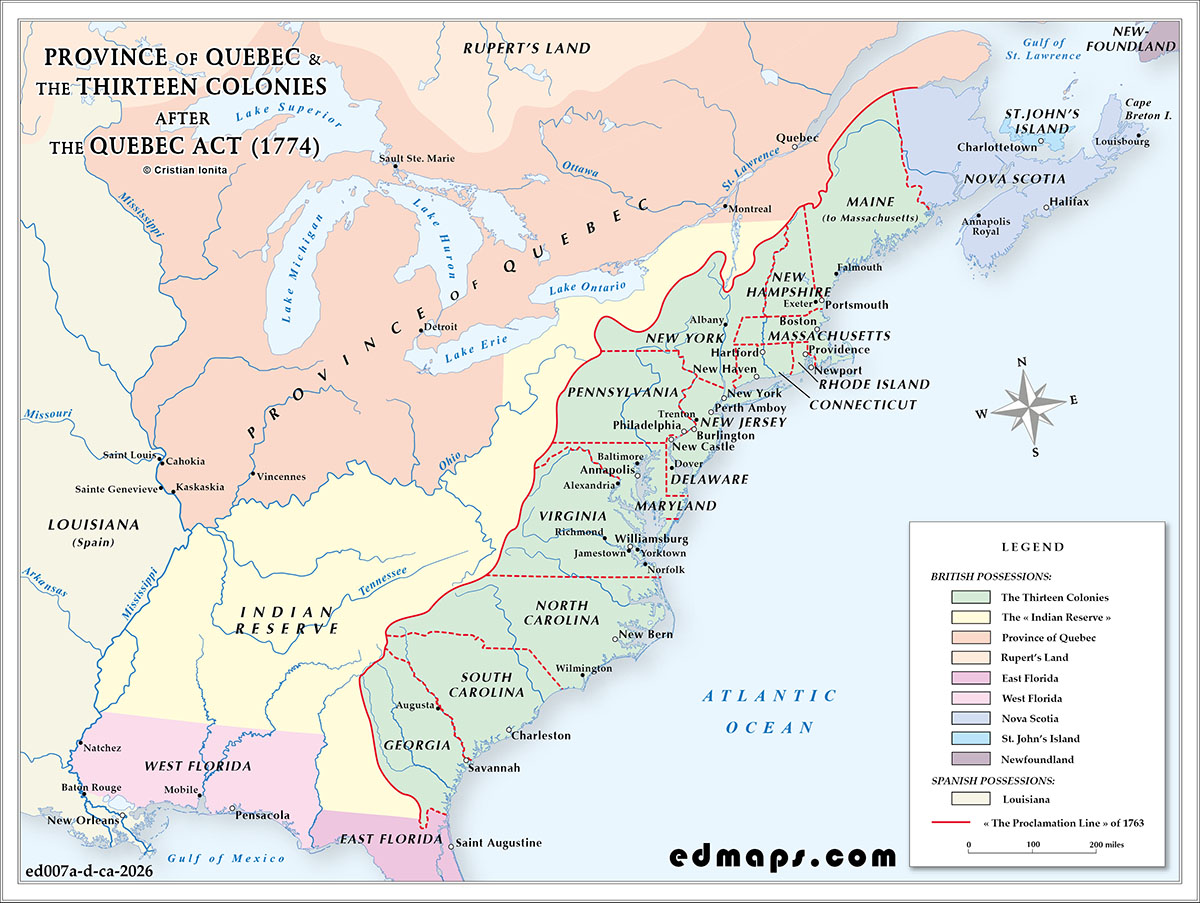
The most striking visual transformation was the dramatic expansion of Quebec’s borders. The province burst out of the confines of the St. Lawrence Valley, absorbing the vast, lucrative fur-trading territories of the Great Lakes and the Ohio Valley, stretching all the way to the Mississippi River. This immense territorial windfall directly blocked the westward expansion of the Thirteen Colonies, effectively encircling them and igniting fierce resentment among American land speculators and settlers.
Internally, the Act institutionalized a unique legal and religious compromise. It restored French civil law while maintaining British criminal law, officially recognized the seigneurial system, and replaced the restrictive Test Oath with a new oath of allegiance, allowing Roman Catholics to hold public office. Furthermore, the Catholic Church secured the legal right to collect tithes, effectively restoring its traditional authority and cementing its loyalty to the British Crown.
To the thirteen American colonies to the south, the Quebec Act was perceived not as a peaceful administrative adjustment, but as a hostile provocation. Branded by American Patriots as one of the intolerable "Coercive Acts," it was viewed as a direct assault on their chartered territorial rights and a dangerous endorsement of "Popery" and arbitrary royal rule right on their doorstep.
This legislative pivot permanently altered the course of continental history. By securing the loyalty, or at least the neutrality, of the French-Canadian population and clergy, London successfully insulated Quebec from the brewing American Revolution. However, in solving its Canadian dilemma, the British Crown inadvertently accelerated the spark of rebellion, drawing a definitive, hostile line between the newly expanded Province of Quebec and the aggrieved Thirteen Colonies.