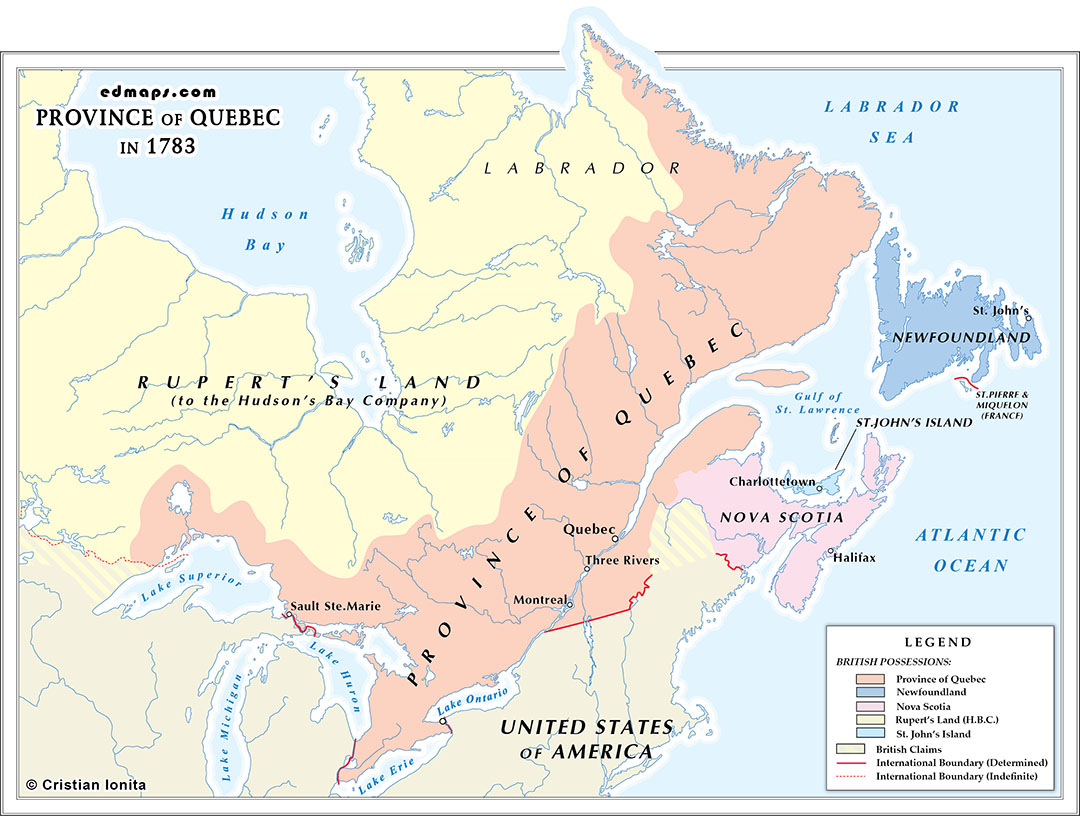
In 1783, the Province of Quebec occupied a central place within the reshaped British Empire in North America. The Treaty of Paris that ended the American Revolutionary War forced Britain to redefine the limits of its northern possessions, and Quebec, already transformed by the Quebec Act of 1774, stood as the largest and the most important of these remaining territories. This moment marked a significant geopolitical adjustment, as imperial borders were renegotiated in response to the emergence of the United States.
The province still encompassed a vast interior, stretching from the Labrador coast to the upper Great Lakes and from the St. Lawrence Valley toward the Mississippi watershed. Yet the treaty imposed a decisive contraction: all lands south of the Great Lakes, formerly integrated into Quebec’s jurisdiction, were ceded to the new republic. This shift reoriented the province toward the north and west, while preserving British control over the St. Lawrence corridor, the Gulf of St. Lawrence, and the strategic approaches to the Atlantic. The other major British possessions in the region, Nova Scotia and Newfoundland, remained distinct coastal colonies whose military and maritime roles gained importance as Britain consolidated its northern foothold.
Within Quebec, the social and institutional order continued to reflect the accommodations established in 1774. French civil law, the seigneurial system, and the authority of the Catholic Church structured daily life, while British criminal law and imperial administration framed the overarching political order. The population, overwhelmingly French-speaking and rural, remained concentrated along the St. Lawrence, leaving the immense hinterland sparsely inhabited and largely under Indigenous control. British officials governed through a pragmatic balance, aware that the stability of the province depended on maintaining the arrangements that had preserved local cohesion during the recent conflict.
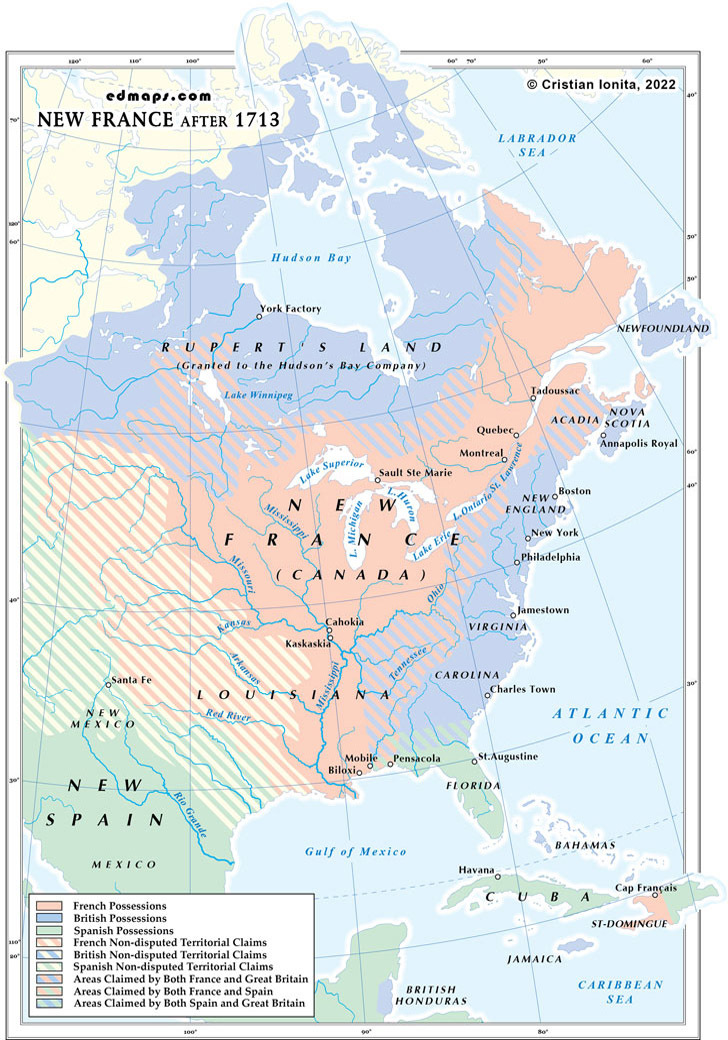
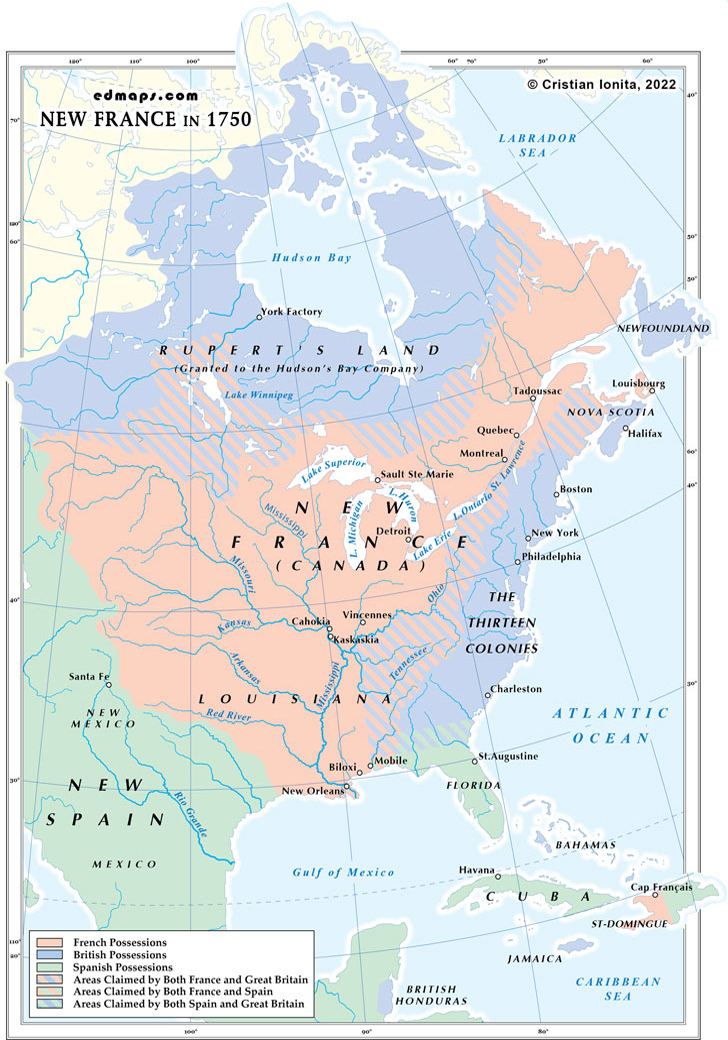
The year 1783 thus represents a moment of redefinition for Britain’s northern empire. The loss of the territories south of the Great Lakes forced London to consolidate what remained, and Quebec emerged as the principal inland possession anchoring British power in northeastern North America. Its borders, though partially reduced, still encompassed a vast and sparsely populated interior, while its social order continued to rest on the French institutions preserved in 1774. In the aftermath of the American Revolution, the province stood at the intersection of imperial strategy, Indigenous territorial autonomy, and the enduring legacy of New France, its geography and internal structure offering a glimpse of the new political landscape taking shape along the northern frontier.